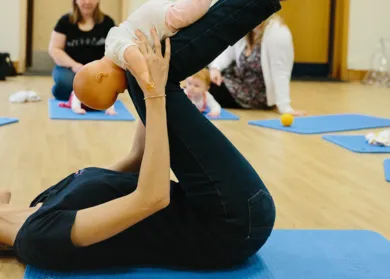
How baby yoga saved my sanity!
Child psychiatrist, parent coach and Mum Victoria Khromova shares her personal and professional story of the importance of attending baby classes for parents and children.
The piercing cry through the baby monitor.
It’s 5am.
Not even an hour of sleep since the last wake-up.
And I know that this is the morning now, that’s it. After 4 hours of broken sleep this is the morning, and I have a long, long day stretching ahead of me.
The monotony of life with a baby
Feeding, changing nappies, taking toys out of baskets, putting toys in baskets, hearing endless loops of the baby music on that baby radio toy my daughter has – which I will be very happy to never see again! Endless walking between rooms as she crawls everywhere – taking books off the shelves, as I put them back on, chasing the cat and getting stuck between the dining room chairs. Battle at nap time because my daughter seems to think that nap times are a kind of torture that prevents her from living her life to the fullest. If we do go out, it’s usually just the two of us – she is so active that there isn’t any point going anywhere where she can’t spend hours crawling, so I can mostly be found in a soft play, getting stuck between those giant foam rollers or trying to make the floating air ball machine work.
The guilt of a new mum
And the awful guilt – the awful guilt of not enjoying any of it, struggling with the monotony, wishing I had more adult time – every day, I wake up with the feeling that something was horribly wrong with me like some Mum part forgot to be added to my brain.
Every day is the same – apart from Mondays.
The help that saved my sanity
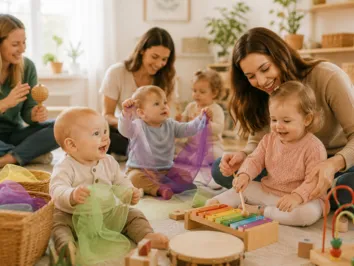
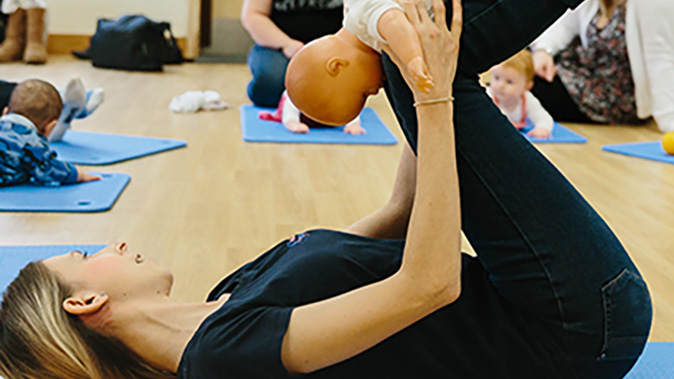
My best friend, who also had a baby recently but lived a good hour’s drive away in Nottingham, booked us into a baby yoga class every Monday. Every Monday, I wake up with a sense that I have somewhere to go. And though, on many days, part of me felt like I just could not be bothered to actually get dressed properly and drive for 2 hours just to do a baby yoga class, part of me knew that this did me a world of good. So I pack my baby bags with military precision and I go every Monday.
I did it for months.
The light
And, of course, it wasn’t the baby yoga itself. My daughter was so active by this point that it was hard to pin her down for any baby yoga moves. But this was okay – all of the mums in the group were completely accepting of this, and as she raced around the place, our wonderful teacher accommodated her beautifully. What really worked was the sense that I needed to go somewhere, that I saw the same friendly faces, including my wonderful friend, that afterwards we all had some lunch and helped each other out with looking after the little ones so we could actually get some food. It was sharing those conversations about the good, the bad and the ugly of looking after babies and not being so alone. And then, of course, on the journey back, my daughter would actually nap in the car, and I would get 40 minutes or so of being able to listen to a bit of music, which felt like bliss.
The long-term impact
My daughter is 7 now, and those times are starting to become hazy in my memory. What I do know, having looked back over that time with a clearer mind, is that I had been suffering from postnatal depression, which unfortunately went unrecognised (even by myself, despite being a psychiatrist!). When I think back – those trips to the baby yoga class were instrumental in my survival at that time, getting through it, and continuing to build a meaningful bond with my daughter. I lived from one Monday to the next. But I wouldn’t have gone myself; I went because someone organised it for me and expected me to be there, and this is quite usual for people who are low; they need someone to start the process for them and get them engaged. In the therapy world, it’s called ‘behavioural activation’.
The evidence to support mental health
Nowadays, I do lots of work volunteering to support parents with perinatal mental health difficulties, and I create content for parents that helps them with their own and their child’s mental well-being. While doing a bit of research for my latest guide around what parents can do in the first year of life to help raise a confident and independent child, I came across evidence that shows how important social support is. For some people, they already have a great support network of friends and family. But for someone like me, for whom both friends and family are far away, that support network can be harder to come by, especially when you are the main carer for a baby. There’s a significant body of evidence showing that support both during pregnancy and in the first year of life helps your child’s development (physical and social) to stay on track. And, of course, your own mental well-being is key when it comes to raising a confident and independent child, too, because being in a stable place allows you to be sensitive to what your child needs and to build that secure interaction. There is also some very interesting evidence that children having different materials to play with and different external experiences outside of the house in the first year of life are two of the four ‘positive family factors’ which are all linked to children doing better both socially and in terms of their academic achievement later on.
My professional opinion about baby classes
Cynics see baby yoga, massage or sensory classes as just something that’s been set up to be sold to parents of babies, something that babies don’t really need. But I feel that could not be farther from the truth! If you look at the wider evidence, then you can see how these classes fit so well with promoting support for the main carer and creating external experiences for the child – both of which are great ways of supporting your child’s emotional development and your own sanity!
Sending all new parents much love!
More about Victoria
Victoria Khromova is a parent coach, child and adolescent psychiatrist, and Mum!
You can buy Little Starts Gift Cards here to spend with baby yoga, sensory, massage classes and more!
You might also like…